Margins of Excess
Max Pinckers
2020.6.2-2020.8.9
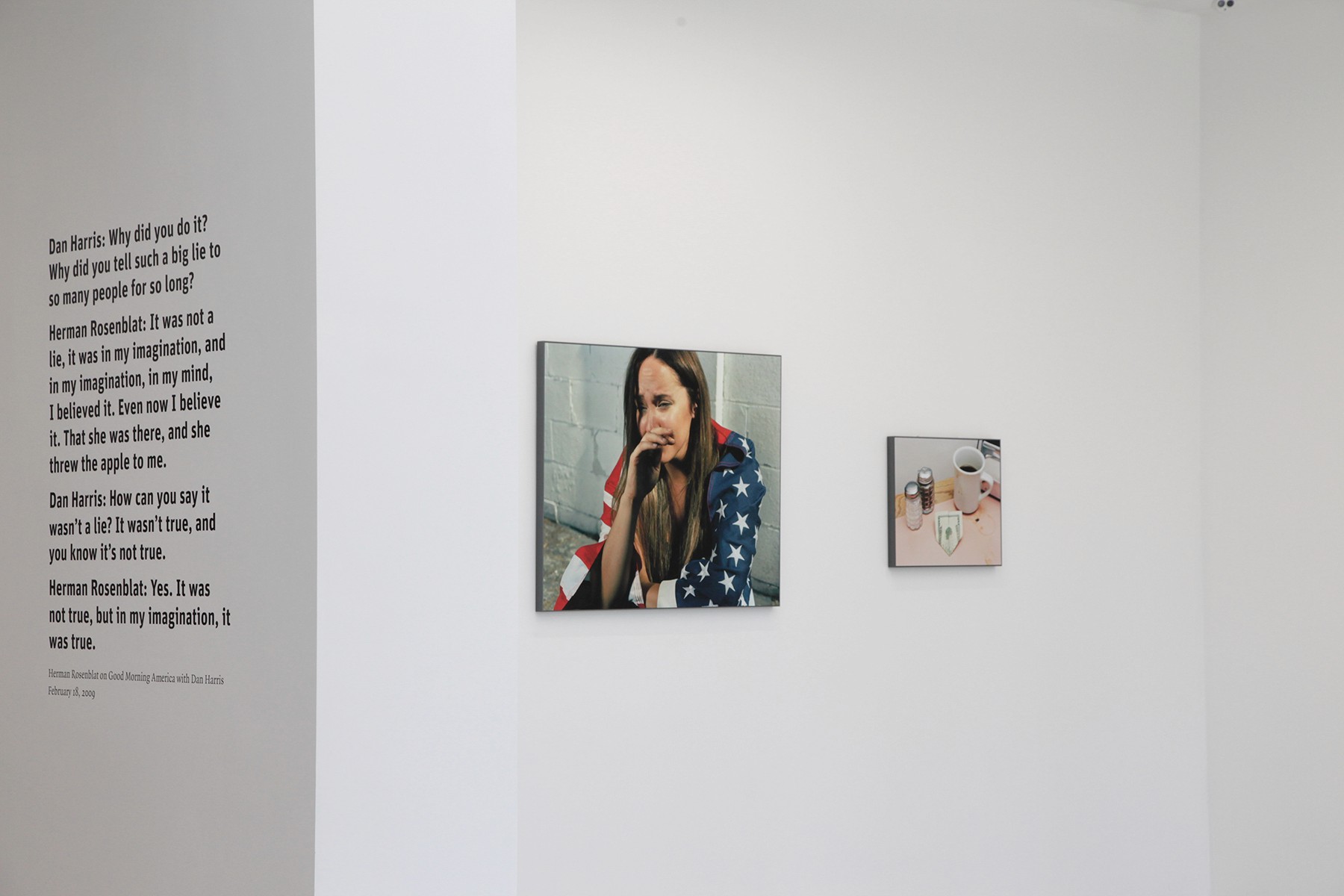
Margins of Excess is Max Pinckers’ photographic practice speaking to the ‘post-truth era’ andexploration of what the documentary photography ought to be with the newchallenge. The project started from mid-2016 when Pinckers and his wife Victoria Gonzalez-Figueras were on their way to a residency in New York City. It was a quite defining moment that a series of dialogue around fake news, alternative facts and the ‘post-truth era’ came after the mid-term election inthe US. News media is always Pinckers’ interest and he found many cases where media couldn’t digest individual narratives and accused them as perpetrator without evidence. Yet the wrongly accused and the media culture in the US arenot Pinckers’ focus. The six protagonists in Margins are individuals who received nationwide media attention because the subjective realities they shaped on their own couldn’t fit the formatted and accepted truth.
The exhibition showcases, yet not limited to, two stories of them. The format is isomorphous to the book Margins of Excesspublished accompanying the project that unfolds in a woven structure instead of divided individual stories. In the book, portraits of the six protagonists (except for Rosenblat who died in 2015) are the only photographs that refer directly to the documentary story. Pinckers deliberately combines artificially lit and staged photographs with abstract photographs he took along the way, found newsfootages, self-conducted interviews, documents and articles from the press. The images and their sequence do not serve the story in an illustrative way as what documentary normally does, but rather render more space for imaginary association. What ties all elements together is its graphic design with different paper stock and placement and sizes of the images. Approaching the characters in the same way, the exhibition includes portraits of James J. Armesand Darius McCollum, next to which are their interviews. These motifs are interrupted and joined by a cluster of associative images from weeping VirginMarys, white suspicious vans to and pretentious mourning. These symbolic imagesare not part of histories of the protagonists, but add and engender more layers to the narratives.
In Margins, most of the images do not point to the subject interms of traditional documentary. The more you go through the works, the moreeasily you get a sense of inverse that these main characters are invented whilethe other images are real since their stories are such farcical and insane. The reality and fiction are intertwined and interchangeable that no defining demarcation line can be found. Yet, simply blurring fact and fiction is notwhat Pinckers tries to do. Margins indeed reflects on the difficulty tounravel fiction from fact, but not intend to create the vertigo where things are indiscernible and cast doubt on whatever reality you confront. That’s the ruse of political figures to fabricate a climate of haunting insecurity as what Donald Trump does. Rather, as Pinckers states, he ‘tries to reflect onhow images direct our perception of that truth and how are they used to push ideological agendas.’ The core of the questions rests on our knowledge and understanding of the reality and wherein the role of the image.
We are used to see what we believe, reiterate what the majority knows and confirm what’s already existed. That is a kind of ‘correlationism’ that Quentin Meillassoux terms, ‘the idea according to which we only ever have access to the correlation between thinking and being, and never to either term considered apart from the other’. To put it simply, the knowledge of a reality independent of thought is untenable. Reality-in-itself is cordoned off in its cognitive aspects. It’s difficult to attain the knowledge beyond how things appear to us, and, precisely, how we intend to approach the reality. In this way it’s not difficult to explain our incapacity to digest and transmit idiosyncratic realities which do not relate to our existing knowledge, or echo certainprevious experiences.
It should not be simply attributed tocurrent media culture or advanced technology that impose us a sense of formatted and ready-made reality which is kind of irrefutable and taken forgranted. Both can be seen as factors, but it’s not the whole picture. There is something intrinsic to reality in the gap between the reality itself and our understanding of it. Sometimes we are so naive to presume a position of external observer from which the entire world can be grasped that it encompasses all of reality by reducing the existence of the individual perspective to a thing in theworld. As Slavoj Žižek states that, ‘the reality I see is never “whole” — not because a larger part of it eludes me, but because it contains a stain, a blind spot, which indicates my inclusion in it.’ Reality, is non-All. There is a gap, a crack, anirresolvable hole within reality itself. Yet we shall not bridge the gap since to do so is to confirm its existence and reinforce that. Only by attending it can we truly get closer to reality with all its complexity. That’s indeed what Pinckers tries to do, getting along with these people who are stuck in the gap, the space where subjective realities couldn’t fit the accepted truth, where unintended content exceeds the confinements of images. In the margins of excess, they are defined by the way they wear the world, the world about which the photographs unearth the narratives. Before they wear it, it is the subjective reality which sews it together.