WORLDING
Liu Hongguo
2026.08.01-2026.09.09

Silence, Ink on grid‑patterned rice paper, 65 × 38 cm, 2026
WORLDING
Liu Hongguo
2026.08.01-2026.09.09
WU SPACE | PRISM
To describe these works by Hongguo as a form of self-"dialogue" might sound cliché, yet it is undeniably true. In these works, one finds little of an active desire to pronounce judgment upon the world. Though many paintings appear to project a stance outwardly—as if the artist were sitting in judgment of reality—they are, in truth, phrased in a "self-directed" syntax. Echoing the themes of titles like Salvation, Barren Mound, and Self-Gaze, these works express themselves through a neutral deployment of vocabulary, an intertextual objectivity in the dictionary sense of words. Bereft of raw emotion or intent, they merely denote and describe one another. They function as an index between various topics within the world, as if the reality of the world depended entirely upon this very index. Naturally, this is felt through the atmosphere of isolation within the picture plane; these are cold works.
This "dialogue" gradually coalesced between 2023 and 2025. In the beginning, the paintings retained a theatrical quality. The central motifs on the background stage exhibited a declaratively gestural pose of graphic form, as seen in Tianma (Pegasus), Rocks Piercing the Sky, and the Stage series from 2023. These were largely self-testimonies poured out toward the world—a mapping of silently enduring motifs into the soliloquies of a lonely body existing in the world. Although Hongguo maintains that his use of standard calligraphy practice paper (Mizi-ge) was unintended, it nonetheless reveals a counterpoint between the support and the artistic expression: the subtle visibility and invisibility of the red grid—a discipline of writing—indicates the degree and limits to which individual action covers it. At the same time, it exposes a profound alienation between his self and the world—one that is far more than a mere coincidence.
This performance of pouring one’s heart out to the world did not last long. By 2025, a distinct shift occurred on the canvas. Most noticeably, graphic motifs began to "invade" one another. Functioning simultaneously as discrete figures and as the underlying substrate for their counterparts, they engaged in a game reminiscent of positive-negative space compositions in two-dimensional design. The Gestalt relation of "figure-ground" thus became intricate and complex. If this reflects a conceptual vision of the world, then so be it. Upon realizing that the recurring circular zones in these paintings represent the schema of the park pond Hongguo looks down upon from above, one understands that the real world has itself become the stage upon his canvas. Crucially, perhaps he no longer wishes to speak directly, but rather allows the world-as-stage to speak for "itself"—allowing the tangled, sprawling world to speak on his behalf. Thus, he transforms the language through which he once alienated the world into the very language the world demands to speak. In other words, this manifests what Hongguo previously described as "becoming the world": the theater of personal utterance converts into a drama of the world stage.
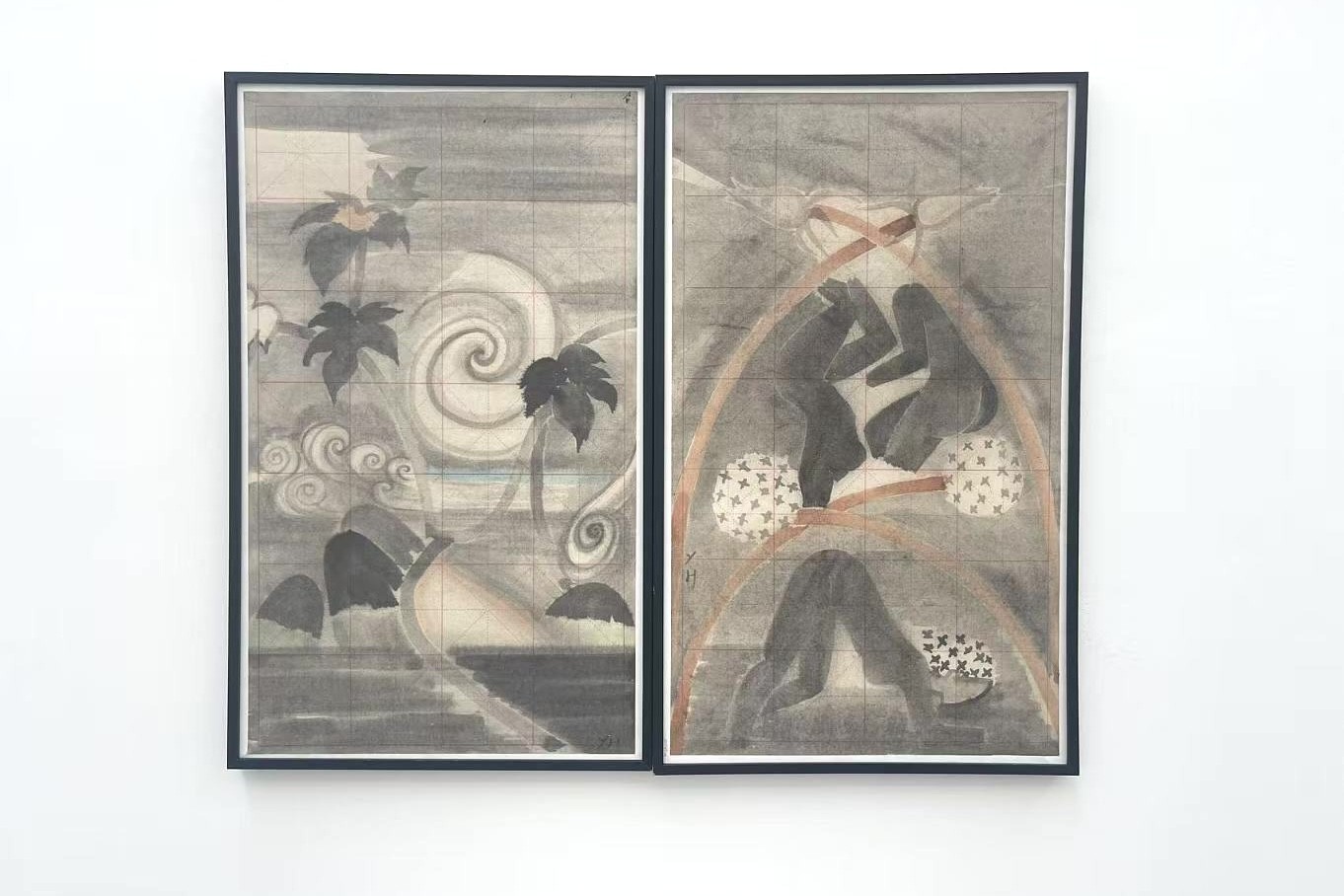
It is precisely here that the iconographic information—the female nudes, bamboo and rocks, flowers and celestial bodies—might not be what matters most. What truly matters is their mutual nesting, reflection, and tacit collusion: as if each motif had renounced its right to individual declaration, willingly dissolving into a figure-ground-reversing hybrid, weaving together across the canvas into a metaphor for the "stage play" of the world itself—a play devoid of any central protagonist. In this drama of the world, every dialogue with the world and with oneself is at once polyphonic and mute; it offers neither conclusions nor acknowledgments, and scarcely any accusation. The world is an infinite, unjudgmental occurrence: while individual utterances may cease, the theater of the world never draws its curtain.
Novalis once wrote:
“Not humans alone speak,
The universe speaks as well,
All things speak,
Languages infinite.”
T.S. Eliot wrote:
“I should have been a pair of ragged claws
Scuttling across the floors of silent seas.”
So long as one refrains from speaking with others and converses only with oneself, with a stroke of luck, one can anywhere and at any moment witness the universe issuing its enigmatic utterances. Hongguo’s "becoming the world" is precisely about merging this enigmatic universe with himself into "one," and subsequently entering into dialogue with the self that has "become the world." A modern assonance occurs—as the mind assimilates the world into linguistic material and feeds it back to itself, it aligns with their shared vowel. The swift movement of the "ragged claws" and the motionless "silent sea" harmonize in assonance into "one": within the inner resonance of mind and world, upon these canvases that have become the world, the surges of the mind and the light and shadow of the world become one and the same thing.
If someone holds that the real world is finite and unbearable, and believes it imperative to somehow transcend the duality between self and world, that person is a Romantic. This Romantic existence is so broad and enduring—stretching from the German Sturm und Drang movement of the late 18th century, through the closing notes of modernist artistic practice in the mid-20th century, until humanity ultimately abandoned interior transcendence and infinity altogether. For Romanticism, as Baudelaire remarked, is something that "can be found only within oneself"; searching outward yields it no more. Herein lies the foundational hue of Hongguo’s art.
Hongguo’s ink art touches upon this question of transcendence, savoring it inwardly amid a contemporary art environment that externally commodifies the world into raw material. In doing so, he bridges tradition and the contemporary through this very framework of Romantic modernity.
Text / Ren Haiding
About the artist
Liu Hongguo, also known as Yi He. He graduated from the Department of Chinese‑Painting, Lu‑Xun Academy of Fine Arts in 1998, majoring in Chinese Painting, and received his Bachelor of Arts degree. In 2014, he obtained his Master of Fine Arts degree from the same department and major. He currently lives in Shenyang. Liu Hongguo’s ink‑wash works operate across three dimensions: the historical, the present‑day and the future, moving freely between them through reflection and refraction. His shifting perspectives reveal the circumstances and destinies of individuals and human communities. His artistic language consistently engages with human perplexity and unease, as well as fragmented and disordered lives. Elements are dismantled and reassembled within ambiguous temporal frames, immersed in and broken free from uncanny spaces, lending his works a persistent dream‑like aura. Visual motifs drawn from reality flicker faintly across the picture plane, echoing the subtle emotional bond between inner mind and external objects. His palette employs desaturated hues, often reduced to black and white alone. Through the interplay of black and white, he distills the expressive power of ink‑wash language.
WU SPACE | PRISM
An independent exhibition initiative launched by WU SPACE. Through the prism, we attend to diverse voices from young artists and creators. In a direct yet un‑reduced manner, we seek new forms of expression at the intersection of identity and heterogeneity, opening up further refractive possibilities for the linguistic spectrum of young artists and creators.
All images are installation views of WORLDING at WU SPACE, 2026. Courtesy of WU SPACE. All rights reserved.